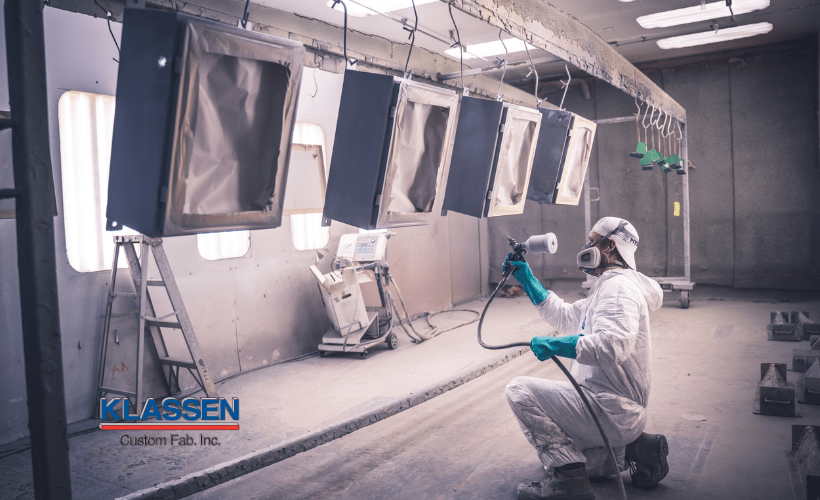
Powder coating in Windsor gives steel and aluminum a tougher, longer-lasting finish than liquid paint. Klassen Custom Fabricating delivers powder coating in Windsor manufacturers depend on from its own facility. Parts move from the press brake to the spray booth to the cure oven without ever leaving the building.
Most buyers treat finishing as someone else’s job. That costs them freight, handling damage, and a second queue they don’t control and when the finish fails, the fabricator blames the coater and the coater blames the prep. Nobody owns it. Klassen Fabrication Shop, can handle it all from 3D design, to fabrication to painting and powder coating.
What Is Powder Coating and How Does the Process Work?
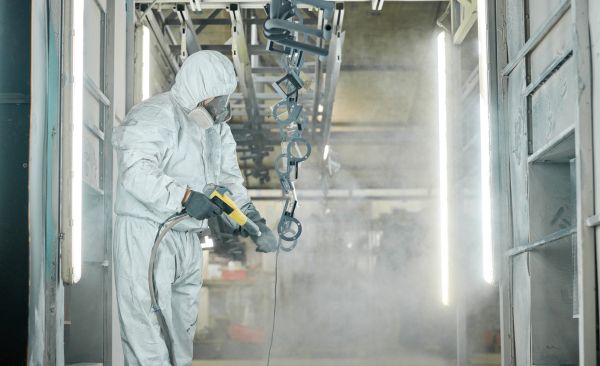
Powder coating is a dry finish. A spray gun gives fine polymer powder a negative electric charge. The powder sticks to a grounded metal part. An oven then melts that powder into a solid shell bonded to the surface.
The powder itself is a dry mix of resin, pigment, and a curing agent, ground into fine particles. No solvent carries it. That single difference explains most of the benefits below.
Application happens inside a spray booth. The part hangs from a grounded rack. Charged powder follows the electrical path to the nearest grounded metal. It wraps around edges and reaches into corners that a liquid paint gun would miss.
Curing does the real work. Ovens hold parts between 350°F and 400°F for 10 to 20 minutes. The exact time depends on the powder and the weight of the part. The powder first melts into a smooth film. It then cross-links. That is a chemical reaction that locks the powder into one permanent layer. The finish becomes a thermoset, which means heat will never soften it again.
Film thickness is the clearest difference. One pass of powder lays down 2 to 4 mils, roughly the thickness of a sheet of paper. Liquid paint often needs three coats to reach half of that.
Powder chemistry covers far more than colour. High-temperature coatings built on silicone resin hold up on exhaust parts and oven components. Specialty finishes add chemical resistance, textures that hide surface marks, or surfaces that shed graffiti.
Why Powder Coating Outperforms Wet Paint on Industrial Parts
Powder coating resists impact, chipping, chemicals, and rust better than liquid paint. The cured film is thicker, and the chemistry binds it into one solid layer. Powder also releases almost no volatile organic compounds, or VOCs. Unused overspray gets collected and reused instead of thrown out.
Industrial parts take abuse that decorative finishes never see. Forklifts strike machine guards. Pallets scrape mezzanine edges. Electrical enclosures sit outdoors through Windsor and Essex County winters and absorb road salt off the 401. A thin, brittle film fails first at exactly those points.
The real comparison is against two alternatives:
|
Finish |
How It Works |
Best For |
Limitations |
|---|---|---|---|
|
Powder coating |
Dry electrostatic spray, oven cure |
Enclosures, machine guarding, frames, platforms, tanks |
Part must fit the oven and handle cure heat |
|
Liquid paint |
Solvent or waterborne spray, air dry |
Oversized weldments, field touch-ups, custom colours |
Thinner film, VOC handling, slower drying |
|
Hot-dip galvanizing |
Dipping in molten zinc |
Buried or constantly wet structural steel |
No colour range, added weight, warping on thin sheet |
These finishes also work together. Galvanized steel that is then powder coated forms a duplex system. The zinc stops rust at the metal. The powder handles abrasion, sunlight, and safety colour.
Which Fabricated Parts Benefit Most from a Powder Coat Finish?
Powder coating suits parts with welded seams, folded edges, and complex shapes. Charged powder wraps corners evenly, which a paint gun cannot do. One cured pass delivers protective film and safety colour at the same time.
Parts heading straight from the shop floor into the finishing area at Klassen Custom Fabricating fall into five groups:
- Custom electrical enclosures that need a durable exterior, with grounding points masked and left bare.
- Machine guarding that needs high-visibility safety colour surviving daily contact.
- Structural frames and weldments, meaning welded assemblies, where the coating must cover weld beads without cracking.
- Platforms and mezzanines where deck edges and stair frames face constant abrasion.
- Hydraulic tanks and coolant reservoirs that meet oil, coolant, and washdown chemicals.
How In-House Finishing Shortens Your Lead Time
Hours disappear the moment parts leave the building. An outside coater adds two truck trips and a wait in someone else’s queue. It also adds a handoff where damage becomes nobody’s fault. Finishing in-house removes all three, so a coated weldment ships days sooner.
The industry runs two kinds of coating operations, and the difference decides who should quote your work. High-volume shops run an automated powder coating line. Parts hang from a moving chain and pass through wash, spray, and cure in one continuous loop. That model pays off at 500 pieces and up, which is why many production coaters turn down single custom pieces.
Batch coating works differently. Parts are racked, loaded into a large oven, cured as a group, and unloaded. Batch ovens handle odd sizes, heavy weldments, and mixed low-to-mid volume runs, which is exactly what custom fabrication produces. A dual-booth setup adds one more advantage. One booth stays on a running colour while the other changes over. That keeps one powder from contaminating the next.
The Finishing Sequence
- Degrease and clean. Cutting oil, mill scale, and fingerprints come off. More adhesion failures trace back to this step than any other.
- Surface preparation. Sandblasting or chemical pretreatment roughens the surface so the powder grips it.
- Masking. Threaded holes, bearing bores, machined faces, and grounding studs get plugged or taped so they stay bare.
- Electrostatic application. Charged powder is sprayed to a target film thickness.
- Batch cure. The oven holds the set temperature long enough for the coating to fully cross-link.
- Inspection. A gauge measures film thickness, and adhesion is checked before packing.
Which Standards Apply to Powder Coating in Ontario?
Canadian work answers to Canadian rules. Powder coating releases little or no VOC content regulated under the Canadian Environmental Protection Act. Ontario shops manage air quality under O. Reg. 419/05, not the federal rules that apply south of the border.
Product standards matter too. Architectural aluminum often calls for AAMA 2604 or AAMA 2605 performance. Those specifications set how well a finish holds its gloss and colour through years of outdoor exposure. Certified electrical enclosures add one more rule. The coating must never block the grounding paths required by CSA C22.1, the Canadian Electrical Code.
An ISO 9001 quality system ties this together. It documents cure records, film thickness readings, and material certificates for every job.
Frequently Asked Questions
How long does a powder coated part take to cure?
Most powders cure in 10 to 20 minutes, once the metal itself reaches 350°F to 400°F. Thick or heavy parts take longer to heat through. The weight of the part sets the total oven time, not the coating.
Can you powder coat aluminum and stainless steel?
Yes. Aluminum, stainless steel, and mild steel all accept powder coating when the surface is cleaned and pretreated first. Aluminum usually gets a chemical pretreatment rather than blasting, because blasting can distort the softer surface.
Will a powder coated finish fade or chip outdoors?
Powder resists chipping far better than paint. Polyester and fluoropolymer powders hold their colour through years of sunlight. Epoxy powders fade outdoors and belong inside. Matching the powder to the environment prevents nearly every fading complaint.
Can you powder coat over an existing coated part?
Strip the old coating first, either chemically or by blasting. New powder over old, failing film traps the original adhesion problem underneath, and the repair lifts again within months.
Ready to Finish Your Next Fabrication Project?
Fabrication and finishing are one job, not two. When a single team cuts, forms, welds, and coats your parts, you get one quality record, one schedule, and one point of contact. For powder coating Windsor plants can schedule alongside fabrication, contact Klassen Custom Fabricating at (519) 737-9611. An ISO 9001 certified process and more than four decades of custom metal work stand behind every job.
The team will walk you through coating solutions for your parts, your volumes, and your finish requirements.
Share This Article
Choose Your Platform: Facebook Twitter Google Plus Linkedin