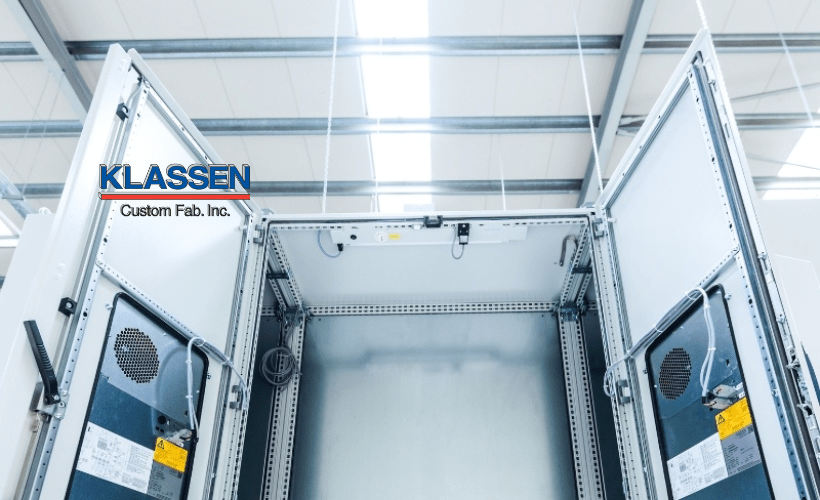
NEMA ratings in Canada show how well an enclosure protects electrical equipment from rain, snow, dust, ice, and corrosion. NEMA enclosure ratings come from the ANSI/NEMA 250 standard, which defines construction, testing, and marking requirements for electrical enclosures rated 1,000 volts or less. Picking the wrong rating costs money, damages equipment, and creates safety risks. Klassen Custom Fabricating builds CSA and UL-certified enclosures that meet the exact NEMA enclosure ratings Canadian projects require.
What Do NEMA Ratings Mean?
NEMA ratings classify electrical enclosures by the environmental conditions they can withstand. Each NEMA type number defines specific protections against solids, liquids, corrosion, and ice formation, tested under procedures set by ANSI/NEMA 250-2020.
The word NEMA stands for the National Electrical Manufacturers Association, an ANSI-accredited standards organization. NEMA 250 is a voluntary consensus standard. Manufacturers self-declare compliance with NEMA type ratings, while third-party testing labs like UL and CSA list products to ANSI/UL 50E and CSA C22.2 No. 94.2. Canadian sites face cold winters, road salt, washdowns, and humid summers. The right rating keeps your equipment running through every season.
NEMA enclosure ratings differ from the Ingress Protection (IP) ratings defined by the international IEC 60529 standard. NEMA testing covers more conditions, including ice formation, corrosion resistance, and oil exposure. IP ratings measure only solid particle and water ingress. Both systems work, but Canadian projects commonly use NEMA type designations to specify enclosure protection levels. Enclosure certification in Canada follows CSA C22.2 No. 94.2, the Canadian national standard for electrical enclosures.
Which NEMA Rating Do You Actually Need?
The installation environment determines the NEMA rating. Indoor, outdoor, washdown, coastal, and submerged sites each demand different protection levels. The comparison table below shows the key differences at a glance.
| NEMA Type | Environment | Water Protection | Dust Protection | Corrosion | Common Canadian Applications |
|---|---|---|---|---|---|
| 1 | Indoor only | None | Falling dirt only | No | Office panels, dry warehouses, utility rooms |
| 3R | Outdoor | Rain, sleet, snow | No | No | Meter boxes, EV chargers, outdoor disconnects |
| 4 | Indoor/Outdoor | Hose-directed water (65 GPM test) | Windblown dust | No | Food plants, dairies, automotive washdown zones |
| 4X | Indoor/Outdoor | Hose-directed water (65 GPM test) | Windblown dust | Yes (200-hr salt spray) | Coastal sites, chemical plants, highway cabinets |
| 6 | Indoor/Outdoor | Temporary submersion (6 ft / 30 min) | Yes | No | Pump stations, flood-prone installations |
| 6P | Indoor/Outdoor | Prolonged submersion (6 ft / 24 hr) | Yes | Yes | Wastewater treatment, submerged controls |
| 12 | Indoor only | Dripping liquids | Circulating dust | No | Machine shops, manufacturing floors, warehouses |
NEMA 1 (Type 1): Indoor General Purpose
NEMA 1 enclosures provide the most basic protection level. They block falling dirt and prevent accidental contact with live parts. They offer zero protection against water, airborne dust, or corrosion.
Office spaces, dry warehouses, and indoor utility rooms suit NEMA 1. Do not use them outdoors or in damp areas. Water and humidity ruin the contents fast.
NEMA 3R: Standard Outdoor Protection
NEMA 3R is the standard baseline rating for outdoor electrical equipment in Canada. It protects against rain, snow, sleet, and external ice formation but does not seal against hose-directed water spray or windblown dust.
Exterior panels, meter boxes, EV chargers, and outdoor disconnects often carry a 3R rating. They handle Canadian winters at a lower cost than NEMA 4 but fail in washdown environments where water hits the enclosure under pressure.
NEMA Type 4: Watertight Outdoor and Washdown
NEMA 4 enclosures pass the hose-directed water test defined in NEMA 250. The test sprays 65 gallons per minute from a 1-inch nozzle at a distance of 10 to 12 feet for five minutes. Zero water entry is allowed.
This test simulates industrial washdown conditions found in food plants, automotive lines, dairies, and outdoor industrial sites. Severe snowstorms also call for NEMA 4 over 3R when the contents are critical. Sealed gaskets and welded one-piece construction make the difference.
NEMA 4X: Corrosion Resistance Plus Watertight Protection
NEMA 4X provides all NEMA 4 protections plus corrosion resistance. Enclosures must pass a 200-hour salt spray test per ASTM B117 standards in addition to the full NEMA 4 water and dust tests.
Stainless steel and fiberglass are the common 4X materials. Use 4X near salt water, in coastal regions, in chemical plants, or anywhere road salt hits the equipment. Highway cabinets in Ontario and Quebec often spec 4X to last decades without rust-through.
NEMA 6 and 6P: Submersion Protection
NEMA 6 enclosures handle temporary submersion at a limited depth. The standard test submerges the enclosure at six feet of water for 30 minutes. NEMA 6P extends that to prolonged submersion at six feet for 24 hours.
Wastewater plants, pump stations, and flood-prone sites need these higher ratings. NEMA 6P also includes corrosion resistance. The sealed construction and corrosion-resistant materials handle conditions that flood a NEMA 4 box in minutes.
NEMA 12: Indoor Industrial
NEMA 12 enclosures protect against circulating dust, dripping water, and oil and coolant seepage in indoor industrial environments. They do not protect against hose-directed water or outdoor weather conditions.
Manufacturing floors, machine shops, and warehouses with forklift dust use NEMA 12. They cost less than NEMA 4 and work well when outdoor weather is not a concern.
How Do NEMA Ratings Apply to Hazardous Locations?
NEMA enclosures used in hazardous locations must meet stricter rules beyond the standard NEMA 250 environmental ratings. Hazardous locations contain flammable gases, vapors, or combustible dust that create explosion risks.
NFPA 70 is the National Electrical Code (NEC) used in the United States. Canada follows the Canadian Electrical Code (CEC), published as CSA C22.1. The current 26th edition, CSA C22.1-2024, took effect in March 2024. Both codes define hazardous locations using the same Class/Division/Group classification system.
Both the NEC and CEC sort hazardous locations into three classes:
- Class I: flammable gases or vapors (refineries, paint booths, fuel storage)
- Class II: combustible dusts (grain elevators, flour mills, coal plants)
- Class III: ignitable fibers (textile mills, woodworking shops)
Each class breaks down into Groups based on the material present. Group A through D cover Class I gases. Group E, F, and G cover Class II dusts. Explosion-proof certification requires separate testing under standards like UL 1203 and CSA C22.2 No. 30, beyond the NEMA 250 environmental rating.
What Should Canadian Projects Consider When Choosing NEMA Ratings?
Canada’s climate puts unique demands on electrical enclosures. The rating that works in Texas often falls short in Saskatchewan. Temperature extremes, road salt, and coastal humidity drive most Canadian rating decisions.
Coastal regions like Halifax, St. John’s, and Vancouver need NEMA 4X to fight salt spray. Galvanized steel rusts within a few years of ocean exposure.
Heavy snow and rain zones require at least NEMA 3R for basic outdoor protection. Motor controllers and sealed control panels should step up to NEMA 4, especially where snow drifts contact the enclosure or ice formation cycles stress the seals.
Road salt creates corrosion challenges across Ontario, Quebec, and the Prairies. Equipment near roads, bridges, and loading docks needs NEMA 4X to survive repeated salt exposure. Indoor environments bring their own issues. Coolant, metal dust, and oil seepage eat through NEMA 1 fast. Stepping up to NEMA 12 indoors saves replacement costs over the life of the equipment.
Why Do Material Choices Matter as Much as NEMA Ratings?
A NEMA rating shows the protection level. The material determines how long the enclosure maintains that protection. Carbon steel, stainless steel, aluminum, and fiberglass each serve different environments and budgets.
Carbon steel with powder coat works for most NEMA 3R and 4 jobs. Stainless steel 304 covers general corrosion for NEMA 4X applications. The NEMA 250 standard references AISI Type 304 as the baseline material for corrosion resistance comparison in salt spray testing. Stainless steel 316 exceeds that baseline and fights chloride corrosion in coastal and chemical sites. Aluminum offers light weight with good corrosion resistance. Fiberglass resists chemicals that destroy metal in harsh industrial environments.
Klassen Custom Fabricating works with all these materials at the Windsor, Ontario custom fabrication shop. The team builds one-piece welded NEMA enclosures that resist leaks better than bolted designs. Every project meets CSA, UL, and NEMA 250 standards. Final inspection confirms welds, gaskets, and finish meet spec before each unit ships.
What Are the Most Common NEMA Rating Mistakes?
The most common mistake is choosing a rating based on price alone. A NEMA 1 box costs less than a NEMA 4 box, but the savings vanish when water or dust damages the contents within months.
Other frequent mistakes include:
- Using indoor ratings for sheltered outdoor sites like loading docks or roof overhangs.
- Skipping NEMA 4X near coastal areas to save on stainless steel.
- Mounting NEMA 3R in washdown zones where hose-directed water hits the box daily.
- Picking 4X based on rating alone without checking the material against site chemicals.
The right approach matches the rating to real site conditions, including worst-case weather and cleaning procedures.
How Does Custom Fabrication Solve NEMA Rating Challenges?
Off-the-shelf enclosures rarely fit specialized equipment. Custom fabrication delivers exact dimensions, mounting points, conduit entries, and access doors while maintaining the required NEMA rating and seal integrity.
Standard sizes leave wasted space or force odd component layouts. One-piece welded construction eliminates the weak points found in bolted multi-piece enclosures. Welded seams create a continuous seal path that outperforms gasket-only assemblies in NEMA 4 and 4X applications.
Klassen Custom Fabricating designs enclosures from the inside out. The team measures your components, plans the layout, and builds the box around the equipment. CAD drawings confirm the design before steel gets cut. The fabrication shop serves Windsor-Essex County, the GTA, neighboring U.S. states, and clients across North America.
Frequently Asked Questions
What is the difference between NEMA 4 and NEMA 4X enclosures?
NEMA 4 and NEMA 4X share the same water and dust protection. Both pass the 65 GPM hose-directed water test. NEMA 4X adds corrosion resistance, verified by a 200-hour salt spray test per ASTM B117. Choose 4X for coastal areas, chemical plants, or anywhere salt or corrosive agents contact the enclosure.
Which NEMA rating do I need for outdoor electrical equipment in Canada?
NEMA 3R is the standard baseline for outdoor electrical equipment in Canada. It handles rain, snow, sleet, and ice. Upgrade to NEMA 4 for washdown environments or heavy snow contact. Upgrade to NEMA 4X near salt water, coastal areas, or road salt exposure.
Are NEMA ratings the same as IP ratings?
No. NEMA ratings and IP ratings use different test methods and cover different conditions. NEMA testing includes ice formation, corrosion resistance, and oil exposure. IP ratings under IEC 60529 measure only solid particle and water ingress. A NEMA 4 roughly compares to IP66, but the standards are not interchangeable.
What NEMA rating works for food processing plants in Canada?
Most food processing plants in Canada require NEMA 4 or NEMA 4X enclosures. Daily washdown procedures use hose-directed water that exceeds NEMA 3R protection. NEMA 4X stainless steel resists both the water and the cleaning chemicals used in food-safe sanitation.
Do NEMA enclosures need CSA certification in Canada?
NEMA 250 is a voluntary self-declaration standard. However, enclosures installed in Canada typically require listing to CSA C22.2 No. 94.2, the Canadian national standard for electrical enclosures. This standard is harmonized with ANSI/UL 50E and covers construction, environmental testing, and marking requirements.
Start Your Project With the Right Protection
Picking the right NEMA ratings protects your equipment, your workers, and your investment. Canadian conditions often call for upgraded materials or fully custom designs. Klassen Custom Fabricating has built CSA and UL-certified electrical enclosures since 1983. The shop serves manufacturing, automotive, commercial construction, and industrial clients across Windsor-Essex County, Ontario, and beyond. Talk to the team about your site, your equipment, and the standards you need to meet.

Contact Klassen Custom Fabricating today for a quote on enclosures built to the exact NEMA rating your project demands.
Share This Article
Choose Your Platform: Facebook Twitter Google Plus Linkedin